Aggression in Adopted Children
Aggressive moments can feel confusing, exhausting, and even frightening.
Presenta: Bryan PostGrabado en ene 202679 minInglés · Subtítulos (CC)
Lo que aprenderás
- Why a child's aggression is so hard to face: their stress triggers your own nervous system and old memories, so you react from survival without knowing it.
- Why knowing about trauma is not enough on its own. Trauma is emotional, not cognitive, so in the moment you need a different experience, not more information.
- How stress makes both parent and child regress to an earlier emotional age, which is why a 17-year-old can act like a much younger child.
- The root of aggression as Bryan Post explains it: unexpressed grief. “Your aggressive child isn’t mad. They’re sad.”
- The three pathways of emotional expression and what to do with each: ignore the attitudes, encourage the feelings and work through the behaviors.
- The A to Z principle: every outburst follows a process, and you can interrupt it long before it reaches aggression.
Transcripción Ver transcripción completa +
0:00Bryan Post here. Thank you for taking time out of your very busy day. We're going to be recording this. Stop recording. It's already recording. It's already recording, right, Jasmine? Correct, yes. Yeah, fantastic. Okay. Good, good, good. It's good to see all of you. I can't see you when I am in presenter mode, so we'll just be right there. Okay, let's go ahead and jump in. So this morning, try to mute your phones if you can or your videos or whatever. So today we're going to be talking about aggression. Aggression and adoptive children. Children, why it happens and how you can help heal it. My name's Bryan Post. For those of you who don't know me, I've been doing this for 30 years.
0:57And I was adopted child myself. I was in foster care for a short period of time. And everything that I'm going to talk to you about today is not only from my background as a clinician and as a consultant around the world. But it is more importantly from my background as an adopted child, as a child who had challenges and a child who grew up in a home with a lot of conflict. I understand this at a very deep level. I am also a parent. I have seven kids. I have three grandkids. I have an adopted son. So I've covered the gamut and all of this stuff. So if you haven't heard of me, I encourage you to just do some further studies. I want all of you to do some further studies. And I'm starting off with this very first slide today that says you haven't failed because you haven't because you're amazing because you're here.
1:56When you show up to continue learning and continue growing, then you have not failed. I had a guy reach out to me on Instagram. If you don't follow me on Instagram, I'd encourage you to do that. It's Bryan Post official. I had a guy who reached out to me on Instagram and he says he feels like he's, he's failing and losing hope. And I haven't been able to get back and engage. I responded to him in the middle of the night. But the reality is, as long as you are making an effort to do something different or to learn something more than you have not failed, you don't fail until you quit. So as long as you continue going, let me tell you, I work with families who have given up. I work with families who don't want to give up. I work with families who have amazing hope and determination. I work with families who have been at all the different levels and as long as you are still trying, you are not failing.
2:58So I want you to know that. I want you to know that. Okay, so here's, here's, here's how I'm going to frame this and I'm going to start off and I'm going to try to give you, I'm going to go for about an hour. I'm going to go for about an hour, potentially do a little bit more. If you have questions, please put them in the chat. In fact, I would love it if you would put in the chat. If you're an adopted parent, if you're a therapist, if you're a biological parent, it doesn't matter to me because it all applies. But it's important to know for me also who it is that I'm talking about because a lot of times I frame what I'm doing and what I'm presenting around parents. So if you're an adopted parent, I want you to put that in chat. If you're an adopted parent in crisis, I want you to put that in the chat. Because I don't want you to leave without getting the support and the connection and the resources to help you work through this crisis.
3:56Right now, and I'm in California, right now I live in Fort Worth, Texas, but the state of California is passing some regulations that are removing children from residential treatment. So a lot of children have been in residential treatment and they are in the process of coming back home. So there are a lot of families and that is a whole different dynamic. There are a lot of families who have adopted children returning home from residential, which is fantastic. But the sad part about that is that they're getting dropped right back into the same experiences and the same dynamics that they had in these families don't have support. And that's unfortunate. And I can go probably I'll do a whole another webinar on another day about the dynamics of residential treatment because by the time a child goes to residential, the parents are exhausted, overwhelmed, shut down, don't want to do it anymore. And then nine times out of 10, and I consult with residential treatment centers nine times out of 10 under the best under the best guidance in the best direction, while the child is in residential, the family gets very little direct engagement
5:11and focus maybe the parents do do virtual counseling or something like that which I'm not a big fan of a virtual I like I like to be in person I've spent the last 30 years of my career working in homes. So I'm very I have a very biased opinion I would say when it comes to where we perform therapeutic services and clinical support. I like to be in your living room I like to get in your home I feel like that's in the entire team at LEAF and I Love Pathways that I, I coach and direct. That's that's the whole education is all about working in the homes because that's where the big breakthroughs are both children come home and families have not been engaged they've not been. brought into into the deeper awareness and healing of the family dynamics. And so then what happens is these these families end up continuing to really struggle and really suffer.
6:12And there's a lot of those families coming so Jasmine are you managing that the waiting room when people when people come in. Yeah. Okay great I won't I won't pay any attention to it. Okay cool.
6:26So here's what I want to do because we're talking about aggression aggression is a very serious topic is a very serious topic. And I want to. As a goal of today. And I love education I love to educate because I believe that that awareness and then education are like the first steps up the mountain. So when you're in I like to frame this in fact at the end of the day I'm going to show you a little video that I had created that I feel like really really demonstrates the essence of families and what we do is that I consider myself an emotional Sherpa. So I've been doing this for so long I've seen so many children I've worked with so many families so many moms so many dads. So many mixed race families so many transgender families it doesn't matter I just I just talked for families.
7:22So parents to parent household single parent household grandparents. It doesn't matter it all applies. And so I've been up this mountain 1000 times and aggression is one of those dynamics that is really overwhelming for a parent and let me tell you why. Because it charges your nervous system and when you've been doing it when you've been engaged in a dynamic where your child is aggressive or where your child where your child is violent. Then your nervous system gets conditioned to a chronic state of anxiety so your amygdala is always on alert. Now that's really important. But here's the second thing that's also important. Your amygdala is on alert. It starts going down into your brainstem stirring old memories so this is where aggression gets really really challenging.
8:23Because aggressive aggressive energy aggressive energy stresses you out into your deepest insecurities anxieties fears overwhelms the traumas. That's why it's so difficult to deal with. When your child becomes aggressive or fiends aggression or demonstrates aggression your nervous system gets hijacked your amygdala gets hijacked. And and the deepest experiences that you've ever had around any kind of aggression any kind of any kind of violence any kind of you know significant bullying or any other life or death scenarios domestic violence. It's all going to get triggered. That's probably the most difficult. Second to that is the family that grew up in a pretty regulated environment or an environment that wasn't really emotionally expressive and soothing when you have a child who's really emotionally expressive again in hijacks the brain and hijacks the amygdala.
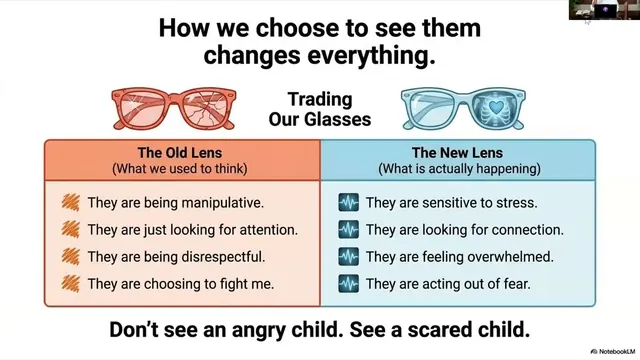
9:26I'm doing this today as an image imagine standing in front of a fun house mirror and I've shared this I've shared this last year this were new slides I had Jasmine create just for his presentations but imagine standing in front of a fun house mirror. You look at your child's behavior and it seems defined manipulating and out of control in this instance it feels aggressive but remember the fun house mirror you look at it and it distorts everything. But in this instance you look in that fun house mirror and you see aggression. That is what you see. But just like that mirror just like that warped mirror what you're seeing isn't the full truth. What you're seeing isn't the full truth what you're seeing as aggression isn't the full truth but we become conditioned to feel that way. The reality is that mirror is a reflection of trauma fear and dysregulation both in your experience and your child's experience.
10:25So then what we end up looking at and seeing in that fun house mirror is not authentic. So every time you respond to what the mirror shows you instead of what's actually there beneath it then you get stuck. They shut down and nothing changes and this is the dynamic. So they become they seem aggression. You see aggression and when you see aggression they get stuck and then when they get stuck that's where they move into fight, fight or freeze and then nothing changes. It becomes a repeat pattern over and over and over again and here's the difficult part. The difficult part is that your brain forms neural networks around these experiences. Your brain forms neural networks around these experiences so that becomes the conditioned experience. So the moment the moment your child gets upset and starts to become stressed and you become hijacked because it happens just like that.
11:27Then you both start pursuing that old neural pathway. That is why it is so overwhelming and it is so difficult to interrupt. Now Bruce Perry said that there are only two ways to change the brain repetition and emotional impact. And in today today's presentation. I'm going to I'm going to speak to both of those. I'm going to speak to both of those. And this is all of you. I would say because you showed up here you've probably all read some kind of trauma informed parenting book. You've probably gone to see a trauma informed clinician. You've probably been to the workshops trauma informed trauma informed trauma informed.
12:21But this is why so many trauma informed strategies fail. Because what we end up trying to fix is the behavior without first correcting the vision. So I stopped talking about trying I was talking about trauma informed 20 years 25 years ago. I mean I've been teaching this this stuff I'm sharing with you today I've been teaching for over 25 years. I was fortunate that way. But I stopped talking about trauma informed I was teaching trauma informed 25 years ago before anyone was talking about trauma informed. Because the reality is now trauma informed is not enough knowing about trauma is not enough being able to explain how the the amygdala is wrapped around by the neocortex means nothing. It means nothing. And that's really the difficult the difficulty of a presentation or of a webinar but just in in Hayward, California, Jebo College, given a presentation foster parents adoptive parents and social work professionals.
13:25And the most difficult part about lecturing, just like you participating in this today is that it's educational and educational. Is cognitive, but trauma is not cognitive. So being trauma informed really means nothing because the moment you become stressed trauma informed goes out the window because trauma is not cognitive. It's emotional. And the moment you become stressed your amygdala hijacks your brain. So the moment you become stressed your right hemisphere, which is your emotional brain, which is tied to your amygdala it's tied to your heart tied to your brainstem tied to your gut, your right hemisphere hijacks your left hemisphere, which is your thinking. That's why when your child starts to become upset, you automatically start to get overwhelmed in 90% of the time you don't even know it and I want to say that again.
14:28Because that is really important 90% of the time when your child begins to get upset if you have a child who you are dealing with aggression. I want you to understand this 90% of the time. And it could be even higher especially if you if you if you've not studied and you know had some therapeutic interactions. 90% of the time the moment your child starts to fiend aggression in a lot of times that's it's it's nonverbal. There that the energy see this is this is so important my goodness and it just overwhelm my brain literally gets overwhelmed when I start presenting because there's so much but it is so concise and it is so simple but it is so difficult.
15:23So it's like I get overwhelmed and how much I want to download into you all in this really short period of time and I have to really slow down. I kid you not I was like standing in my closet putting on my shirt and I'm like I'm going to be I'm going to be much more much calmer today in my presentation and then I'm going to get feedback and see how that works. I can't do it. I'm too passionate. I'm too passionate. I see this too clearly. 90% of the time your child starts to generate an energy a stress vibration everything's vibration. So for some of you that may be hard for you to wrap your brains around, but that's just physics. I mean everything is a vibration. So your child starts to get activated and start sending off a vibration and Daniel Goleman and emotional intelligence talked about this 25 years ago.
16:22The stressed out amygdala sends a signal to the other amygdala and your amygdala is a part of your fear receptor in your brain. I'm going to point that out in just a moment. And those signals what happens is your amygdala interprets that that vibration and it goes down into your brainstem and starts looking for a matching experience. So here's something really important. Man. And this is for this is for clinicians too. Let me pay Jasmine how many clinicians did how many clinicians are on here. I want to I want to did anyone any of the clinicians or therapists or social workers mentioned like in the chat. Yeah, we had some therapists child therapist.
17:17Perfect, perfect, perfect, perfect. Okay. So, and I'm so excited. I'm so excited to have you all here. I mean, it really, it really is an honor to be able to share this time and the space with you. And I really want to elevate you and uplift you if you have questions I might not be able to get to all the questions. I mean, I have time. I have some time this morning. So if you have questions put them in the chat please. I want you to think as an individual, whether you're a therapist, whether you're a parent, whether you're a grandparent, whether you're a teacher, social worker, I want you to think about you. Because this is where it becomes so important, because everything that I'm teaching comes from a deep framework of self understanding and mindfulness.
18:13So for 20 for over 20 years, I've been doing deep emotional process work. So mindfulness has been a core mindfulness practice has been a core of my, not just what I teach, but of my day to day and living for years, breathing for years. So that these things become just, it's just second nature for me. But these are not easy things because they're not common things. So here's what happens. Let me see what this next slide is. It's not your fault. It's not your fault because you haven't known. You haven't known. So here's what happens. We'll stay right here for a moment. Going back to the vibration. And we like to focus on children, right? Because they're children are the identified patients. And I have a big issue with that.
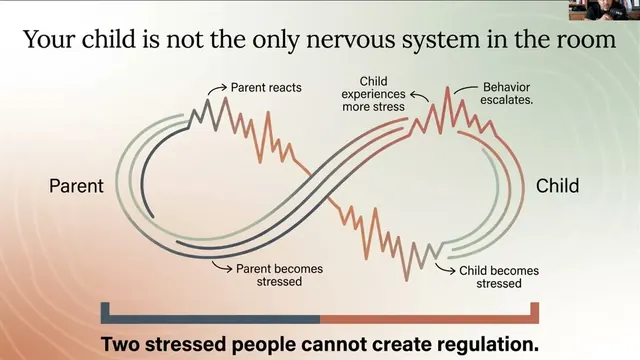
19:08I work with families. Doesn't matter who shows up. I work with families. I always start with parents because parents are the healing force in the home. You know, I just want to establish that. So when you, I believe that when we take the child out of the family dynamic, we're only treating a portion of the dynamic that is really feeding the issue. And I'm going to dig into that in a moment. But here's what happens. The child or other adult, because some of you may be in, you know, challenging adult relationships. Because this is human behavior. Everything I'm talking about is human behavior. I'm just putting it in a framework of children and parents and families. The child becomes stressed. They send a vibration. That vibration triggers the parent's vibration or your vibration. And it goes down to your brainstem. It starts looking for a matching memory. And then that's when it, that's when it releases the memory, which is an energy, which is a past experience. And then that's what changes your lens.
20:11So that, that's, that's when your lens become different because of the vibration of your past experiences. Now this is the same for therapists. For therapists, when a parent or a child gets upset, the therapist feels the same vibration. Therapists are no different. We're no different from anyone else. I've been a therapist. For those of you who don't know, I have a bachelor's, a master's, a PhD. I just don't use credentials because credentials, they don't mean anything to me. I am, I'm, I've gained more from my life experience and my experience working with families than I did anything in school. So none of that matters. So when, when we get triggered, we are informed by our brainstem memories and that vibration changes our lens. What happens from that lens, that lens causes us to become stressed. Now, I'm going to tell you something really important.
21:09Joseph LeDoux, long time ago, 20 years ago, he wrote a book called The Emotional Brain. And he said, in times of stress, our thinking becomes confused and distorted and our short term memory is suppressed. So in times of stress, so when, when a child sends a vibration and our amygdala, which is our fear receptor, let me look at it. Let me get to it. Yeah. Our amygdala, our fear receptor receives that vibration. Then it sends a signal cortisol, your primary stress hormone, which bypasses your hypothalamus, hits your hippocampus. And he says that in times of stress, our thinking becomes confused and distorted and our short term memory is suppressed. I have got to get you to see that. That is so big. It is so big.
22:12That is for therapists. That is for parents. That is for kids. That's for everyone. The kids are the buy product. The kids are the outcome of us clinicians and us parents. The kids have the least mature brain development of all of us, whether you have all of us adults. We're all adults. Put all your labels aside. We're all adults. If you put our brains next to a child's brain, whose brain is supposed to be the most mature? Our brain is supposed to be the most mature. But as soon as a child gets stressed, guess what happens? We get stressed. And when we get stressed, Joseph LeDoux says our thinking becomes confused and distorted and our short term memory is suppressed. So we immediately, and now, now we take into consideration social conditioning, we immediately move into survival. So we want to control. We want to suppress and we want to change the behavior because we perceive the behavior as a threat.
23:13We perceive the behavior as a threat. And as we perceive the behavior as a threat. And Jasmine, if someone has a question, interrupt me, please.
23:20I have a couple of some folks telling their stories. There's one. I would like to know at what point the aggression should be addressed with calling 911 or residential treatment. This would be for a 10 year old at his age, developmental level, three to seven. Okay, we'll talk. I think that, I think, so let me, let me say something very important. Anytime that you feel so afraid that you think you need to call 911 or 911 or you need to call the police, then you need to call them. I cannot tell you when you should make that call and when you should not. When you feel scared enough and at risk enough that you need to make that call, then you make that call because that's your survival mechanism. There's nothing wrong with that. When you get scared because we get scared too.
24:20We get scared as clinicians. We get scared as parents. We mimic and model and mirror our children's terror because when we get stressed, we're all kids. That's what I want all of you to understand. When you get stressed, you regress. When you regress, you go back to an earlier developmental emotional place so that no one can judge you. No one can blame you if you got called cops because you are terrified. And I can guarantee you if you're that scared, your child is so much more fearful. It may look like they're not, but they are terrified. So you call the cops if you need to. Let's just answer that right there. But here's what I want to do. I want to create enough of an understanding so you can start to see this differently.
25:17When we become stressed, not only is our thinking confused and distorted and our short-term memory turns off. That's all of us as adults when we become stressed. But when we become stressed, we regress to earlier emotional ages and developmental milestones. So you might become Allan Schore. He wrote a book called Affect Regulation and the Origin of the Self in 2001. I think in that book, he quoted Taylor et al.. Let me just show. Let me show you. This is so important. This is so important. I may not even put it in here. Allan Schore quoted Taylor et al.. 1997 is saying affect dysregulation being stressed out as a fundamental mechanism involved in all psychiatric disorders. Affect dysregulation being dysregulated as a fundamental mechanism involved in all psychiatric disorders.
26:15Dysregulation is being stressed out. Regulation is experiencing your stress within a window of tolerance. When that stress exceeds your window of tolerance, you become stressed out. When you become stressed out, you act out. When you become stressed out, not only are you acting out and not only are you stressed out, but you regress. Now you are operating from a deeper, earlier emotional place. You are not operating at your cognitive age, your chronological age, your physical age. You're operating from your emotional age. Someone just had a breakthrough. I felt it. Someone just had a breakthrough. I felt it. I love that. I love that. And I know this a lot. This is a lot to put together, but it's actually not. It's actually not. Let's get back to the brain here. Where did that brain side go? Okay.
27:13Now think about this for a moment. Your child has a window of tolerance for how much stress they can handle. I want all of you to hear this. I want all of you to hear this. In fact, let me just jump right here. Okay. A couple of things. Trauma isn't cognitive. It's emotional. Very important. Trauma isn't cognitive. It's emotional. So you're hearing me. You're learning some of your taking notes. But the risk and the challenge to that is that this is not something you can write down on a piece of paper. Because when you get stressed, you're going to forget it. This is an emotional experience. That's why it's so difficult. That's why aggression is so difficult. I can't tell you how many parents I have worked with who get so conditioned for fear.
28:12Like the fear takes over. And let me tell you, you and your child are going to lose as long as the fear reigns in your family and in your relationship and in your home. I had a mom. I did a very short consultation with this mom. I had never met this mom. I was, my team just said, can you talk to this mom? And I said, okay, hopped on the phone. And I said, Hey, what's going on? She's like, you know, I have 17 year old and I'm scared of him. And it just, you know, it's just bad. And the reason I'm telling you this is because I want you to, I want you to understand how the brain gets locked in to a fear based. pattern and can't see anything different. See when the, when the brain gets, gets locked in to a fear based pattern, that, that is a path, that is the formation of a pathway.
29:13So that becomes conditioned. And if you struggle with your child long enough, you're locked into these brain based, these fear based patterns that are really hard to break. I'm going to just, I'm going to wager to say that on your own, it's almost impossible with mental health support. You have a lot greater likelihood, but you've got to have the right focus. You got to be looking at it the same way. You got to have the right guidance. That's why I refer to myself as an emotional Sherpa, because it's like we're climbing the, we're climbing the, the, the Himalayas. Everyone, everyone in life is climbing the Himalayas. And we all suffer because every day we're going to suffer because life is full of suffering. Of course we want to find joy, but some of you are going to suffer and you're just going to suffer. You're not even going to try. It's just going to sound too hard.
30:08You're going to get stuck. You're going to be in those conditioned patterns. You're just not going to try. You're just not going to try, but you're still going to suffer. Some of you are going to try to climb the Himalayas by yourself, which I commend that. And you're going to suffer as you're going to climb and you're not going to make it. You're not going to make it because you've got brain-based, fear-based, conditioned patterns that are already locked in. And you don't have a society and a community that supports you to see it differently. So you're going to climb up there and before you get to base camp, you're probably going to be dead. Or you're going to have turned around and you're going to go back down the mountain. But you're still suffering. You're still suffering because we're all going to suffer. Now, some of you are going to get the right guidance from an emotional Sherpa. And everyone knows that if you're going to climb the Himalayas successfully, you got to have a Sherpa. And that doesn't mean we're not going to suffer.
31:05I know I've got parents on here that I work with, some that are in our wraparound program. My team works with and there's not a single one of you that could say that anything you've been asked to do has been easy. It's all been hard. You're going to suffer. We're going to suffer. But the difference is I've been up and down the Himalayas a thousand times. So I know where base camp is. I know where the major suffering points are. I know what it's going to take. Suffering is a part of the equation, but I know that we can get to a breakthrough. I know that we can create healing because I have a framework that allows me to have seen it over 30 years, over 30 years. So we're all going to do that. So I talked to this mom and that's what I want to do. I want to walk alongside you to the best that I can. I can't handhold all of you, but I got different resources. I'm going to share with you at the end of this presentation.
32:02Nothing that costs you anything. I've been doing this for so long. I mean, I had so much information, but what I want you to get is that if you want to get to healing, you've got to have an emotional Sherpa in some form or fashion. So we'll talk about that. So I talked to mom. She's scared of child. She's locked herself in the bedroom at night with with with her dogs. You know, he comes. He beats on the door. She's she hears dad works out of town. Mom's scared. She's locked. But here's what I know. Now think about this and I know this. The 17 year old that's beating on her door is not 17. The 17 year old that's beating on her door is like a three year old could be a two year old and depending on when he was adopting what he had experienced.
32:59He could be in a two year old left in a room all by himself or left in a motel room or had strange men coming in and out. Hey, Bryan. Yes. So this kind of ties in perfectly into a question they had. So when you talk about our emotional age, do you mean that's when we first experienced trauma as a child ourselves? It's referred to as your developmental Bruce Perry says you revert to your developmental zone of comfort. So it would be the point. So if you're going along developmentally and you're comfortable and then something really stressful occurs, something traumatic occurs, then you get stuck. Trauma creates developmental and emotional barriers and it gets stored in our bodies. So then when you get stress, you reverse reverse back to that's why most of you you're adopted children when they're stressed, they're they're conception of five.
33:58Some of you have 17 year olds who get stressed and they act like babies because they regress back to infancy. The challenge is that some of us get stressed and we revert back to adolescence or we revert back to five or we revert back to being babies. So now you got a baby or you got a five year old trying to parent a baby not going to be effective. It's not going to work. So that happens all the time that I mean that's that's that's like a part of the condition pattern. That that is the condition pattern. And so what that is all what that really is about is unexpressed grief. See trauma is any stressful event which is prolonged overwhelming unpredictable. And when you haven't had an opportunity to express process and understand it, then it gets stored in your body in a fragmented in your brainstem and in your body in a fragmented way. And so anytime you get really stressed, that's what gets triggered and you regress Allan Schore in his in his in Affect Regulation and the Origin of the Self.
35:00He said some adults have the ability to regress to infancy. They didn't met analysis of trauma. Of course they do because it's conception to five that forms the emotional footprints of your entire life. Conception to five.
35:22You want to focus on your children, but you got to look at yourself first. Not because I'm blaming you. I want to help you. Blaming doesn't help. I want to help you. I want to empower you. I want to guide you. I want to encourage you. I want to uplift you. When I tell you to look at yourself. I am setting you free. Your child becomes stressed instead of focusing your lens on the stress and what you're seeing the aggression. Focus your lens on yourself and what you are feeling. And then ask yourself, when have I felt that way before? And then your body, if you listen, your body will take you right back there. Now, continue with that anxiety. You might have to get really quiet. So anyway, let me finish the story. The mom said, she likes herself in her room and I said, here's what I want you to do.
36:22I said, when he comes home from school today, I want you to prepare his favorite meal. That's just really hard to hear when a parent has been mired into a fear cycle. I said, prepare his favorite meal. I said, don't even ask him about school. You know, just, she's like, oh, you know, he's probably not going to, he won't, he doesn't eat anything that I ever cooked. So this is the, this is the conditioned pathway. He doesn't eat anything I ever cooked. This is the fear pathway. It's already conditioned. I said, well, what I want you to do is eat what, cook what he likes. I said, just make his favorite meal. I said, and then don't, don't really talk to him about school. You know, just, just, just listen and be supportive. And she just gave me all these fearful reasons why she couldn't do it. And then she said, she committed to trying. And then I said, I'm available.
37:17I said, call me. If, if things get really stressful, just call me. I'll be available. And, and so the next day she called me. She was like, I said, okay, well, how'd it go? She said, well, we had a good evening, but, but I love that. We had a good evening, but see, that's what fear does to your brain. You get so conditioned. You get so conditioned for fear that you can't see any positivity.
37:54And here's something I want all of you to do. And this is not to bypass the hard work because you got to do the hard work. But I want all of you to find one thing today that you can do with your child or around them or for them that releases joy. That is a joyful experience. Whether you do it for them because you know, they, you know, they like it. And it releases joy or you do it for yourself and it makes you feel good to do it. And it releases joy because joy is the opposite of stress. The opposite of cortisol is oxytocin. So you get your brain is locked in a cortisol pathway. This is, this is, this is the essence of aggression. Your brain is locked in a cortisol pathway.
38:49Your child's brain is locked in a cortisol pathway. So you must, you must have an aggressive experience. You don't, there's no other option except to have an aggressive experience.
39:02But what I want you to understand is that the root of aggression comes from unexpressed grief. Okay. I'm going to sit that simple and I'm going to move on because I just want you to process it. The root of aggression comes from unexpressed grief. Your aggressive child isn't mad. Your aggressive child is sad because trauma isn't cognitive. It's emotional. Your aggressive child is not mad. They're sad. They're not mad. But you can't see the sad because all you can see is the mad. And if all you can see is the mad, if all you can see is the mad, then the sad gets buried and that's how you stay stuck. Because if all you're attending to is the mad, you're in survival.
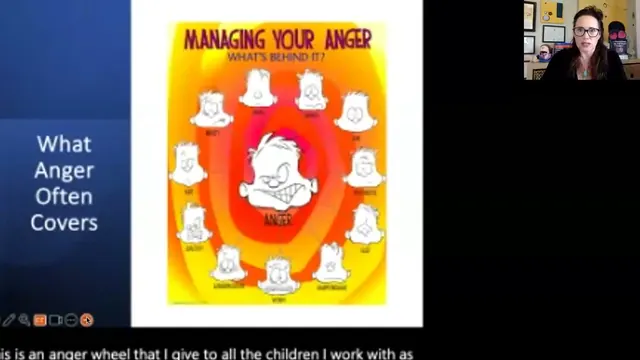
39:57They're in survival. And then both of you just go through the dynamic until everyone's exhausted again. You have to be able to override, override after you become aware, override your anxiety and your fear to be able to see your sad because you're sad too. And then see your child sad. Underneath they're mad. Underneath they're mad is sad. Underneath their anger is their fear. Underneath their survival is their hope, their goal, their aspiration to thrive. But it is all rooted in stress. And stress, the experience of stress between yourself and your child or if you're a clinician, see what clinicians, what happens with clinicians? Because you get trained. You get trained to work with children separate from the families.
40:53Then I say this all the time in my clinical training. Anytime you're working with someone else's parents unconsciously, it's like working with your own. So this is a little caveat for clinicians. I want you to think about this. Anytime you're working with parents, you're unconsciously working with your own. And I watch clinicians because I coach clinicians, I consult with them, I set in sessions with them. I watch clinicians not consciously but unconsciously bypass any role of the parent in the dynamic and the conflict and the struggle of the child. I watch it all the time, all the time. And that cannot lead to healing because it can't lead to a breakthrough.
41:48It can't lead to an emotional breakthrough. So I'm going to make this, I'm going to simplify this for all of you. If you have an aggressive child, you have a sad child, you have a child who's not grieved. And if you have an inability to be present and support that child in their anger, in their anger, then you most likely have pain and trauma and loss that you've not grieved either. And the triggering overwhelms the both of you so you cannot be present. You move apart from one another instead of towards one another. Very important, very important. The feeling is the path to the healing. So this is a breakthrough. This is a breakthrough for all of you. This will be hard because our society is not conditioned for this. Our society actually has inverted our thinking.
42:46Our society and our homes and our schools have conditioned us to do the exact opposite of what we should do. From the time you were an infant, your feelings have been being suppressed. Whether it's someone giving you a Kleenex, whether it's someone shushing you as a baby, whether it's someone ignoring you as a baby, whether it's someone yelling at you to don't yell, to don't cuss, to don't talk to them, to talk to them that way. The unconscious experience is that feelings are not okay. So feelings get suppressed. And guess what happens to feelings that get suppressed? They have to be expressed in other ways. Feelings that get suppressed have to be expressed in other ways. It's just like in grief, grief, grief, the experience of loss. When you've not been able to express grief, it gets expressed in other ways.
43:43Stephen Covey says upset feelings never die. They're buried alive and come back to something uglier. The feeling is the path to the healing. This is going to be huge. If you can really feel, and I know some of you are already doing it and I just love it. I love it. I love it when a parent has been struggling with their child for years, and they start to see the different paradigm, their lens starts to change. And before you know it, the parent, instead of going from night after night after night of crisis and calling the police back to the parent who asked the question about calling the police, I've got parents who still call the police. They're on the healing path, but they still call the police. Calling the police is not a problem. Do what you got to do, but you still got to realize that when the police are done, you still got to get back to the relationship and to the healing. The police don't solve anything.
44:39They don't fix anything. Residential doesn't solve, doesn't fix anything. It just prolongs the time. It gives you a little bit of space for you to be able to work these dynamics out so that you can get back on the right track. It makes me feel so good when parents have struggled and struggled and struggled and see, I know where they're going. See, I'm the emotional Sherpa. I've done it. I've been up and down the mountain. I'm walking alongside them. I'm taking the calls at 10 o'clock at night. I'm taking the calls at midnight. I'm processing in the middle of the day. I know where they're headed and they don't quit. They don't give up because I can, I can support them. I can guide them. I can guide them and guess what they say eventually. We've had a really good week. We have been laughing and having fun. I know you're on the healing path. Now you might stumble and fall and hurt yourself and have a setback with that.
45:35It's okay. We're going to get up and brush ourselves up and we're going to move on. So here's the breakthrough. The breakthrough is that the feeling is the path to the healing. Your children have been conditioned not to express their feelings. Now let's talk about that. Let's talk about that. This is good. The A to Z principle is important. But I'm going to talk about three pathways. Then I'm going to back up to this. I'm going to answer a few questions. Okay. And then give you all a few resources. And then we're going to call it good. And I'm going to be doing one of these a month on different topics. If you have, if you have different topics, if you have specific topics you'd like for me to do these presentations on, I'll be doing these once a month. I'm going to do the other thing. I'm going to share something with you. I created an app called Bondify. It's basically Bryan Post on your phone.
46:31You can ask it any question and it's going to give you an answer. It's going to engage you like we're having a text exchange. It's called Bondify. I'm going to show you in a minute. It's free. There's not a single one of you, whether you're a clinician, whether you're a parent, whether you're a teacher, there's not a single one of you that shouldn't have Bondify if you are ready to walk up the mountain. You walk alongside you. I'm about to start doing weekly webinars for my Bondify members. Weekly webinars for my Bondify members because we're going to do a research, a research study. Because I believe that if you use Bondify for 90 days consistently, you let me walk alongside you. I believe they don't have a significant, I think it'll have a empirically significant, statistically significant result and impact. I believe that.
47:25So here's the three pathways of emotional expression. Okay. There's attitudes. There's feelings and their behaviors. The first thing you have to understand is that emotion is energy in motion. Emotion is energy in motion. So anytime you experience an emotion, it's energy is moving. So when you get stressed, stress is an energy. So the energy gets started. Now here's the thing. We were all taught you can't have attitude. You can't roll your eyes. You can't huff and puff. So then what happens is your child has an attitude and you shut it down so it gets suppressed. This is the first catch. You got to catch this. Because if you don't catch this, that energy that doesn't get expressed gets suppressed and it goes down to feelings.
48:21Now when you've been conditioned to believe that you can't express your feelings, you can't yell, you can't scream, you can't cuss, you can't have all the feelings that you want to have, then the feelings, the energy of the feelings, the energy that is the essence of the feeling gets suppressed and that feeling has to become expressed and you go down to behaviors. That's where we're at. We're at behaviors. But those of you who struggle with aggression, you're actually beyond that because we don't like behaviors in our society when we're stressed, we want to control, we want to suppress, we want to change. So then what happens is you have anger and depression. I have watched a parent back a child into a corner unconsciously because they just could not recognize their own anxiety and their own fear. And so the child is getting stressed, the parent's getting stressed and the parents use the words
49:16and the child's using words and the parent is controlling using whatever thing they can to control whatever resource and that could be no game time, no dessert. You're not going to go here. You can't do this. Control, control, control. And then the child starts yelling and fussing and the parent says, I'm not going to talk to you as long as you're yelling. I'm not going to talk to you as long as you're pressing. And then the child says, well, it's not fair. And the parent says, it's my house and you know, you got, you got to do better. Sometimes the parents like, you got it. You know what? I understand you feel that way, but you just got to do better and it can be completely calm. But the energy is so intense. Oh man, that energy is so intense. And finally the child has no other outlet. They have no other outlet except to freak out and attack or throw
50:11or run away even or break something. If you got a child, I'm just sharing this with you. This might be really hard for some of you, but I've been doing this so long. It does you know good for me to hold back. If you get your feelings hurt, that's okay. Think about it. Why are you getting your feelings hurt? And I don't say anything hurt anyone's feelings. So if you get your feelings hurt, ask yourself, what is that about? You're looking at me like I'm some kind of perpetrator, which I'm not. I'm here to support you and uplift you. Nothing that I'm going to say to you is not to encourage and inspire you to motivate you. If you have a child who is aggressive or violent or destructive, they have learned that that is their only
51:09pathway for emotional expression. They've learned that that's the only way that they can get the energy out. That doesn't just happen automatically. Now, the foundation of that could be from their early history. So the seeds of that could have been birthed a long time ago. So that's just wired into them. But what has happened over time is that you've reinforced that this is the only thing that you can do as an outlet. And then as soon as they do it, you freak out. But watch the pathway because here's what happens. Not only are you living in a state of trauma, a state of stress equivalent to trauma, but here's how you know, here's how you know you've got conditioned, suppressed emotional energy in your home. And this could be a much bigger list. And I'm going to add to this list actually because a lot of times we see a list
52:04and we get so dialed in. Now let me back up for a minute. So here's what you got to do. I didn't just say that. I just said it so simply. Here's what you got to do because it's simple. It's not easy. So I'm telling you, but I'm also honoring the fact that this is not easy. Here's what you got to do. You got to ignore the attitudes. Ignore the attitudes. Everything you learned about an attitude and disrespect is wrong. You've been lied to. You've been lied to for generations and all these ideas about children being disrespectful and rolling their eyes and huffing and puffing. It's not okay. It is a lie. It is a parental myth. It is a byproduct of trauma from generations. That's so hard to hear, isn't it?
53:00Doesn't that make some of your ears ring? If you will listen to what I just said, you will have a revelation today. Where did you learn that attitudes were not okay? And who did they learn it from? And why did it become such a big deal? Because that's the first key. Ignore the attitudes. Child drops into the feelings and I'm making this really quick. Child drops into the feelings. Encourage the feelings. Want the feelings. Need the feelings. The feelings and the feelings are the pathway to the healing. The feeling is the pathway to the healing. So you want the feelings. You need them. Stop telling your child not to yell. Stop telling your child not to curse.
53:56I'm not telling you it's okay for your child to curse. I'm not telling you that. What I'm telling you is that they are already cursing. Telling them not to curse is just suppressing them more. The moment your child feels like they can express themselves, they will stop needing to curse. The moment you get back to focusing on the relationship, you can influence your child not to use naughty words. But right now, stop focusing on that. It's not important. Want it. However they communicate to you, want it, need it, want it. Say give it to me. I want to hear what you have to say. My parent, the other day, the parent called me. She was arguing with her 17-year-old in the car. And the mom said, I want to hear what you have to say. And the 17-year-old said, My mom got quiet.
54:52She said, I'm still here. I want to hear what you have to say. We get so stressed. Your kid gets so stressed and they have so much conditioning about you not listening that they can't even hear when you're actually listening. It's a conditioned pattern. It's easy. It's simple. It's not easy. It's simple. It's not easy. Connection over correction. Connect first. Connect first. Don't worry about correction. The definition of discipline is to teach not to punish. Ignore the attitudes. Encourage the feelings and work through the behaviors. If you're in the place where your child is in their behaviors, then this next slide is going to really, really mean something for you. As they are in the behavior, I want you to encourage them to have the feelings. I learned this.
55:48I framed this working in a group home for adolescent boys at-risk, high-risk adolescent boys. This is where I understood this because when they came to us, they were kind of like, you know, because when they came to us, they were conditioned for anger, depression, and behaviors. And we didn't do consequences. We didn't do restraint. We didn't do timeout. We didn't do any of that stuff. I knew, I found out, I learned really quick, it took six months to 12 months for them to work out of the negative conditioning of anger, depression, and behaviors. So what that meant is that for six months, we would have to support them while they're in their behaviors because they're locked into the behaviors. Then you ride the behaviors out. You wait because you've already been doing this. Some of you have been doing this for years. You wait and then after the behaviors are done,
56:44then you talk about what happened. What did I miss? I'm sorry. I missed it. I didn't see it. I didn't know what was going on. What was the signal? What do you need from me? How can I do this better? This is all paradigm shifting stuff. You didn't have to do it with your biological children nine times out of 10 because they have a different neuronal foundation. If they have a different neuronal foundation, then they dealt with stress easier. They can regulate stress more effectively. But you're adopted children who are more sensitive. You can't get away with it. So you got to do the hard work. So what you have to do is you have to support them through their behaviors to get them up to their feelings and when you get your child to your attitudes and your feelings, guess what? You're winning. You're winning.
57:39When you get a child to attitudes and feelings, you're winning because what do we do as adults when we're stressed out? We have attitudes and feelings. But when it comes to our children, we don't want them to have attitudes and feelings. So then we suppress them down into behaviors and before you know it, they're in residential treatment, medicated, diagnosed. Children model. They model what we demonstrate. And what we're demonstrating is not that attitudes and feelings are okay and that's what you got to get to. Now, one more side. Here we go.
58:15So here's the thing. Aggression is Z. Now, when I talk about aggression, I am talking about like physical attack. I am talking about physical assault. I am talking about violence. Like I'm talking about a kid who's grabbed his mom, got her on the couch and he's pulling her hair and he's pissed. That's what I'm talking about. Aggression and violence. Some of you, some of you are labeling aggression and violence and you ain't dealing with aggression and violence. You're dealing with a child who's yelling and expressing their feelings. Now, when that child starts throwing stuff at you, now you're dealing with some aggression and some violence. But when they're expressing their feelings and they're yelling and cussing and doing everything, you're not dealing with aggression and violence. You're dealing with a child who's trying to express their energy. Now, let me tell you why they end up in aggression and violence
59:10because you can't support them in their feeling expression because you're getting overwhelmed. And when you get overwhelmed, you go down that same pathway of doing the same thing and expecting a different result. You can't stay present. You can't say I want your feelings. Give it to me. Let me hear it. Thank you. And just ride the tide with them. You can't do it. So then because you can't do it, the energy's got to come out so they go into behaviors and that's the aggression and the violence. Aggression and violence is Z. Z. Let me see. Let me show you how this works. Z is the behavior, it's aggression and the violence. If they're not attacking you, you're not at Z yet, but you got to see that. Now, if they're attacking you,
1:00:06we got to ride it through. We got to ride it through. When they get to Z, but before they get to Z is the key because here's what happens in our society, all's we focus on is X, Y and Z. We're so focused on the aggression and the threat and the fear and the overwhelming and all you want to do is control it, suppress it and change it. You can't support it, you can't understand it, you can't encourage it. So you get locked, you're locked in a negative feedback loop. It happens in your brain, you get locked in a negative feedback loop. That's the X and the Y and the Z and what I need you to understand is that what we focus on X, Y and Z is an outcome. It is an outcome and I'm going to set you free today. I want to empower you. I want to empower you so much.
1:01:02Before you can get to Z, what did you learn in kindergarten? You got to start with A. There is a process to every outcome. Please hear me. I'm begging you to hear me. There is a process to every outcome before your child gets to violence and throwing things and destroying things. There is an entire process that they go through. The beauty of this process is that you have the ability to interrupt it. You can interrupt it. You can actually start reconditioning their brain. When children and parents start doing better, it's because the parents start interrupting the negative cycle and start giving the brain a new experience.
1:01:59They're interrupting the same negative pattern and they're giving the brain a new experience. What's a new experience? Let's say at night time I just had a mom in a lecture the other day. We were doing the same thing. Her child had attacked her and I said, yes, what can you do different than night before? Ladies and gentlemen, moms and dads, brothers and sisters, what can you do the night before to change the outcome? It's the process. What can you do in the morning? What can you do at breakfast? What can you do while your child's at school? Can you call your child at school and tell them about what you love them? Can you put a note in their lunchbox? Can you put a note in their home school? Maybe school is just too stressful. I'm just rattling things off here.
1:02:55All of you, there are 25, what is this? 20, there's 20, 24 of these. 24, and this is just the alphabet. There are 24 different things that you can do to impact the outcome. And if the outcome is already a conditioned process, then you've got to start doing something different as soon as possible and it starts with your own attunement. You've got to work on connecting to what overwhelms you and where that comes from. I'm going to give some, this just struck me. Some of you, I may never, I may never work with again. Some of you I will. Some of you I already do. We're going to be doing a parenting intensive
1:03:53in Sacramento and I think I might open up a few spots and it's usually our parenting intensives are for our wraparound families. If you are an at risk adoptive family, you have adoption assistance. Your child has been in therapy, they need more help, or if you're a clinician and you've got a family who you've been struggling with for a long time, they receive adoption assistance. They have a diagnosis. They get a letter from a mental health professional. They have a wraparound program that works with families in Northern California and Central California. If you're in Northern and Central California, actually over to the Bay, San Jose, we're developing a team over there. Napa Sacramento, Fresno, Stockton, Modesto, Yuba, Chico, Redding. Raise your hand
1:04:49if you're in crisis and you need help, you have an adopted child from a state in California, a county in California, then you may qualify for adoption assistance and we can support you, we want to support you. For those of you who don't fall within that criteria, I'm going to open up a few slots to my parenting intensive. The first slots are for our families in our program, but we usually have a few slots. So you will get notified of the opportunity but let me tell you something. Okay, slow down. My thoughts are jumping around because I know I've gone over the time I was going to go. You can change the process. You have the power to change the process
1:05:44and you might not be able to do it every single time because the brain is conditioned. Your brain is conditioned, your child is conditioned. So then what happens is that you'll go five days and on the sixth day there will be an issue. We work through it, work through it and as soon as you work through it, come back to the A to Z principle and ask yourself, hold yourself to task and challenge yourself and say when did the stress start to set in? And then just do better, apologize to your child and just do better next time and then ask yourself what happened two days or that two hours? The window of tolerance. See some of you are having challenges every day. That means your child
1:06:39has a very small window of tolerance for how much stress they can handle. So your A to Z principle has collapsed within two hours. Within two hours. So what can you be doing on the front part of that hour? What can you do at five minutes? What can you do at 10 minutes? What can you do at 20 minutes? And so forth. That strengthens that window of tolerance. See some of you aren't there. Some of you just are having episodes every other day. Well, when you have an episode map it out on the A to Z principle. Hold yourself accountable and then what happens? Listen to me. What happens is that your brain starts to learn a new pathway. And as your brain is learning a new pathway you start creating a new pathway
1:07:35opportunity for your child. So I have a mom who we have worked with. I have actually worked with because she's a part of our wraparound program. And sometimes when it's really intense I get called in. And when I mean intense I mean attacking the mom and the team gets stuck and doesn't know what to do. So I'll come in and lend support. And so I've been working with them pretty consistently over the last 90 days. And mom is experiencing her son getting upset and holding himself. His window of tolerance is expanding. That is such a powerful experience. See a lot of you are byproducts of a system that says you've got to fix the behavior. You don't fix s**t.
1:08:31You don't fix s**t. Can I tell you that? Can I tell you that that's just another one of those parental myths? That's just another lie. That's just one of those generational negative teachings that you've that you've encountered. You're not fixing anything. You're not fixing anything. You're creating a new experience for your child's brain and for your brain to learn a new pathway. You're changing their brain. You're not fixing anything. So we have this quick fix mentality. And that's why we want to that's why we want to send kids residential because we think it's got to fix it. It doesn't. That's why we do medication. We think he's going to fix it. It doesn't. That's why we got to call the police because we think it's going to fix it and it fixes it for a moment. But then the next day you got to deal with the same stuff. You're not fixing anything.
1:09:26So you got to break out of that that victim mentality that says you're that you're disempowered because you're not. You have power. I'm giving you the power right here. Right here you have the power A to Z principle where it's at. OK. What we got here. OK. I got a video I'm going to play for you. Jasmine. You there Jasmine. Yeah. There's no sound to this video but there's a little music. Tell me if you can hear the sound. Can you see it? You can see the video. Right. Yeah. Some folks have been saying that it might be a little hard to see the split screen. Oh. Oh I bet because they're on their phone. When did they say that? They said that pretty. Let's see. Towards the end. Yeah. 106. Yeah. That's OK. We're experimenting.
1:10:22It'll make it good for the recording. Everyone's going to get the recording. So that's going to be cool. So you're going to get the recording. It'll be much better if you can watch it like on your laptop. So I don't think about people chiming in on their cell phones. I don't know why I don't because I guess because I'm teaching up my laptop. Let's watch this record. I think you didn't share sound. That's OK.
1:11:30And that's what this is about. This is about supporting you on your journey. You cannot do this alone because it is it is too difficult. It is just too challenging. And even for those of you my my colleagues my brother and sister therapists that have joined in. You can't do this alone because so much of what what goes on in mental health is going to work against you. And that's why I create every opportunity I can for parents to be able to get support. And this is one way not just for parents but for clinicians. You can use this as a clinician. Bondify is one of those ways. It's just free. This is free. You don't have to pay for anything. You can talk to me on your phone every single day. You can ask me questions your biggest challenges. And I'll be doing I'll be doing webinars
1:12:25in Bondify as well. So I want you to engage in this. Now you see one of our logos from one of my companies called Fear to Love. For those of you clinicians that might be interested in certification I have a full certification program that I do. You can get certified in my Fear to Love methodology. Just go to Fear to Love dot com and you can learn all about it. So that's available. I don't want you to walk alone. I want you to let us walk alongside you. And if you're an adoptive family and you're at risk then reach out. You know, put a put a message here in the chat. Jasmine will see it. We'll follow up. I'll send you the I'll send you the recording. I want to support you. Let us walk. Besides you see if you qualify for wraparound. And if you don't get on Bondify you don't Bondify. And then there's so much information out there that I've provided. I teach every almost every day
1:13:20I'm teaching. Follow me on on Instagram Bryan Post official. You can go to my Bryan Post YouTube page. You know, if you're if you're looking for wraparound services go LEAF wrap around or Love Pathways.org. It's LEAF Wraparound.com and Love Pathways.org. He post. So I have someone who said who do you turn to when you have exhausted your village. I just wanted to kind of bring up how Bondify and Fear to Love itself have different communities. We also have a Facebook community as well that I can add in the chat for you to join. Their parents going through similar struggles you can talk to them. We also have Fear to Love coaches on there that you can bring up an issue or a problem you're struggling with and they can comment and other parents
1:14:16can also give you feedback. Yes. And there's also the adoption community. So when you've exhausted I mean how I can't there's probably so many adopted families on here who can say the exact same thing. And I didn't even get to talk today about my my adopted family. But you know that your network gets exhausted because they don't know what to do. They get just a stressed out and that's the thing. Everyone is stressed. And so if everyone's stressed and your child's stressed how can we do anything different? So you've got to get into a community that has a different understanding one that's going to remove your stress but one that's going to help you work through the stress to see it differently so that you can eventually you can eventually teach and guide and help your other family members and your extended community.
1:15:12Let me give you something simple. I'm going to give you something really simple. Start telling your friends and your family members that your child is stress sensitive and fearful. Don't lead with diagnosis. Don't lead with their traumas. Don't lead with their behaviors. Say they are stress they're stress sensitive and they're fearful. When they get stressed they become scared and when they get scared it drives their behaviors. So get them just like you got to train yourself. Train your community to see stress and fear instead of focusing on behaviors all the time. Okay. What else Jasmine? Coaching on the go. Other questions? I see some hands raised.
1:16:08I see [attendee] and I see an iPhone. I believe those were from our folks in Napa and Northern California interested in our wraparounds. We did have some folks let me see. Go ahead.
1:16:34So this one's just like if our adopted son loses it and yells and screams at us is it possible that that's better for him than keeping feelings inside and retreating around him? Yes. Of course. But here's the thing listen to the words if he loses it. See that has a negative connotation. Let's change him losing it to him giving it to you. And let's let's think let's reframe him giving it to you as him giving you his pain him giving you his trauma and the only way you're going to help him get to a place of healing is if he can readily learn that it is safe to give you his pain and his hurt and his trauma and his fears.
1:17:30He's not losing it. He's not losing it to you. Now he may be losing it up to this point up till today because you didn't want to hear it or you couldn't take it but after today I don't want you to have the framework of him losing it. I want you to have the framework of him giving it to you because the feeling is the path to the healing if the feeling is the path to the healing my God you want it you got to have it you got to have it okay guys I got to go. God bless you. Thank you for joining us. We're going to get everyone everyone the the recording will make sure that that gets sent out. We may follow up with some kind of survey. I'm not sure exactly how that works out. Remember Bondify go to your Apple store go to your Google store
1:18:26download Bondify we walk with you. If you're a clinician go to Fear to Love if you're at risk of having a family in Northern California reach out to us and let's see if we can serve you. I love you. Thank you so much for showing up and I'll talk to you again very very soon.