Regulate Yourself First (Even When You Feel Like You Can't)
Children often borrow regulation from the adults around them. This training helps parents and caregivers better understand their own nervous systems, stay emotionally present during moments of escalation, and use practical self-regulation tools that model calm, safety, and connection during difficult situations.
Presenta: Bryan PostGrabado en oct 202655 minInglés · Subtítulos (CC)
Lo que aprenderás
- Your child feels your state: through mirror neurons, what you feel is what gets reflected back to your child. Your child feels your stress, and your child also feels your calm, so “your calm can become their calm.”
- Why a stressed child cannot learn: “in times of stress, our thinking becomes confused and distorted and our short-term memory is suppressed” (Joseph LeDoux). Discipline means to teach, not to punish.
- Stress pulls us out of the present moment: it makes us react from the past and obsess about the future, while the present is the only place where we can influence what happens next.
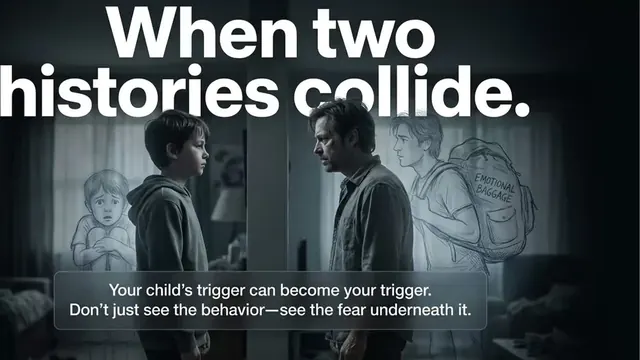
- When we are stressed we regress to our developmental zone of comfort, so a stressed child acts much younger than their age, and so do adults. “When two stressed people collide, boom.”
- Hit pause before you react. Before you correct, lecture, punish or fix, ask yourself one question: “Am I regulated?” If the answer is no, regulate first: breathe, slow down, soften, and tell yourself, “I'm not gonna die, everything's gonna be okay.”
- You don't have to address it in the moment. Wait until your child's thinking and short-term memory come back online, then repair: “A couple days ago you had a really rough afternoon and I didn't handle it so well.”
Transcripción Ver transcripción completa +
0:00Perfect. All right, we have a fantastic presentation for you all. Thank you so much for joining me. I'm Bryan Post in case you do not realize that. I am your host with the most today. I'm going to share my screen with you and we're going to get going on. Regulate yourself first even when you feel like you can't. I have a webinar for parents and caregivers. So we're talking about and I know we have a lot of parents on here. I also know we have a lot of professionals. And here's what I want you to understand. It all applies because it all applies to us first. It doesn't matter if you're a parent.
0:46It doesn't matter if you're a professional. At the end of the day, what matters most is the regulated environment that we create first that starts with us. And when we get hijacked, then the entire environment changes. When we can stay regulated, when we can stay present, when we can keep breathing, when we can stay attuned and aware, then we're able to control the environment which matters the most. And that is us, the self-environment. And that's what we're going to be getting into today. This is really good stuff. This is a really good topic. So if you don't know who I am, I'm Bryan Post.
1:31I've been doing this for almost 30 years. Written 22 books, sold over a million copies of those books. I have all the credentials. I don't use credentials. I just prefer people calling me by my name because that's what my mother calls me. And I didn't learn any of this stuff in college. So credentials, credentials, whatever. I was a foster child. I was adopted. I'm a husband. I'm a father of seven. I have three grandchildren. I'm actually in New Mexico for a few days getting to see a couple of my beautiful grandchildren. So that is always uplifting and inspiring for me. So that's who I am. And this is what I do. And I've been doing this for a long time. I was born to do this work. So your child feels your state.
2:16I cannot underscore that enough. And let me tell you about that specifically. We all have four levels of memory. We have a cognitive level. We have an emotional level. Then we have a motor level, that's your movements. And then we have a state level of memory. Your state level of memory is stored at the level of the brainstem. And what do we know about the brainstem and the state level of memory? Is that they hold every memory we've ever had from conception. Your state level of memory even carries your generational memories. So it's all stored within the state. Now what else is in the state level of memory? The state level of memory is where
3:02your personality traits are stored. Okay, so you're following me. So we have cognitive. And I like to, for some reason my brain is wired that everything is always from the bottom up. It's from the inside out. I'm gonna stop the share for just a moment. See, this is what I do. I get to talking and then I ramble on and then in an hour I'm like, oh my God, there's so much I didn't wanna, I forgot to cover. So I'm gonna try to get focused. But let me tell you something. So you have, your cognitive level is on the top. So if you're writing this down, write cognitive, under cognitive, write emotional. So your cognitive is your directions, it's your names, it's your phone numbers.
3:48Your emotional is the memory that's attached to all those things. So even a phone number can have an emotional memory attached to it. A face can have emotional memory. Have you ever seen someone that you used to work with but haven't seen him in a long time and you actually forgot their name but you saw their face and you immediately had a good feeling? That's an emotional memory. See, it's not conscious. It's very unconscious but it's an emotional memory. Underneath that is your motor. So your motor memory, that's your moving, that's your driving, that's your putting on your clothes, brushing your teeth, that's all motor. And then under that is your state level of memory. Now, your emotional, your motor
4:36and your state level of memory, those are 98% unconscious. You have no conscious awareness of those memory systems. So when those memory systems get activated, you don't even know why they're actually being activated. You typically think it's something on the cognitive level but nine times out of 10, it's not. It's something, it's an emotional memory that's been treated. It's something in the motor system and it's also coming from the state level. Now, here's what's really important. When the emotional memory gets triggered, it controls all the other memory systems. That's really important. So if you think about it, everyone's always talking about left hemisphere, right hemisphere. That's how we look at the brain. The left hemisphere is your cognitive
5:22but your left hemisphere only makes up a quarter of your brain. Your right hemisphere, which is your emotional brain makes up the other three fourths. So when your emotions get triggered, they actually dictate to your cognitive. That's all really, really important because your emotions and your right hemisphere is the hemisphere that's directly connected as neural circuitry. Neural circuitry runs down your spinal cord to your heart and to your gut. So when your emotions get triggered, it's not just like getting mad at someone. Your entire body gets activated and then that's what dictates to the cognitive. So when Joseph LeDoux said, now I've been saying this for 25 years,
6:10Joseph LeDoux, New York University Neuroscientist wrote a book called The Emotional Brain. In that book he says, in times of stress. Now, if you put this together, if you put this together, in fact, if you put this together, you can hear sort of, but if you get what I'm about to say next, and let's say your employer has told you you can be here on the next hour. If you get what I say next, you write that down and you turn off this webinar and you do nothing but think about that. Because if you think about what I'm, if you really get it, what I'm about to say, it changes everything. And that's just like one of 773 things
6:56I'm gonna say that could change everything, but this is a big one. In times of stress, and I love this one for teachers, this is so important for teachers, but it's so important. If you're a human being, this is important. I know I could have some aliens on here and that's fine too, but if you're a human being, this is really, really valuable. Listen to this. Joseph LeDoux, in times of stress, our thinking becomes confused and distorted and our short-term memory is suppressed. When we become stressed, our thinking becomes confused and distorted. And we cannot remember. Now, if you think about this for both a teacher and for a student in the classroom
7:42and you think about all the stressors, as soon as we become stressed, like really stressed, we can't think clearly and we can't remember. Now think about all the times we get upset with the student because they're not thinking clearly or because they're not learning or because they won't sit still, they won't close. We get so upset and then what do we do? We punish, right? We point some rewards, we threaten, we shame, we get mad, we do all the things that are actually the very opposite of what we should be doing. And when that happens, all's we're doing is fostering more confused and distorted thinking and shutting down the short-term memory. The child literally cannot learn
8:27when they are under stress but do you realize that for 25 years I've been teaching that and the number of people that actually get it is so small because it changes everything. If you actually get that and see Stephen Covey says to understand is to do. So if you say, oh yeah, I understand that but if you don't do differently then you don't actually understand it. If you really understand that, if the teacher, the most effective teacher understands that, then guess what they create in the environment? They create calm, they create understanding, they create connection and that's why I say connection before correction because you have to connect to help the child regulate to get within their window,
9:12back within their window of tolerance so they can think more clearly and they can remember if you don't do that it's all for naught. And that's why children grow older and don't grow better. And this isn't even, this isn't even that webinar believe it or not but that is relevant to you as the parent or you as the professional because if you're stressed and you're trying to discipline your child, remember what does discipline mean? The definition of discipline is to teach, not to punish. So if you're trying to discipline your child to teach them and you're all stressed out, then guess what you're teaching them? You're teaching them reactivity and if they're misbehaving
9:58that means they're already stressed. So what's happening with their memory circuits? They're not learning. And so then you end up having to teach over and over and over again and what does Einstein say about doing the same thing and expecting a different result? That's the definition of insanity. Where does insanity come from? From overwhelming prolonged uninterrupted experiences of stress, the root of insanity is stress. So I digress but I don't really digress and now let's get back to it. All right, I'm gonna, man, I'm gonna shake and bake through this so y'all better be ready. I hope you have plenty of coffee and I'm still drinking coffee and I don't even think I need it. Your child feels your state.
10:43Your child feels your stress. Your child also feels your calm. Your calm can become their calm. Now let's talk about this again just from a basic neuroscientific point of view. We all have mirror neurons. Oh, what does that mean? That means the neurons in our brains reflect the experience of the person we are interacting with. So if your child is upset and you are upset, guess what is being mirrored to your child? You're upset. So when this says your child feels your state, it's because when you are stressed, they feel that state. When you are calm, they feel that state.
11:28Two different experiences in the brain, but what do we also know is that we all have, we all have an emotional thought field, meaning we all have an experience because we're all vibratory. We all have an experience that whatever we're feeling is projected 10 to 15 feet outside of us. 10 to 15 feet outside of us. So whatever you're feeling as a parent, you're projecting that feeling. Whatever your child is feeling, that feeling is being projected. Now, their little emotional thought feels probably aren't as strong as the adult. So let's say there's like five to seven feet, but for the adult, it's 10 to 15 feet.
12:16So whatever you're experiencing, whatever you're feeling is what's getting projected out to your child. All right, let's keep cracking here. When stress takes over, we react before we think. So we control, we shut down, we yell, we threaten, we lecture, it all comes from stress. It all comes from stress. Stress pulls us out of the present moment. I love have been teaching this a long time too. Stress does three things. Stress causes us to react from the past, obsess about the future, and takes us out of the present. Oh, this is so important, so important. When you're stressed, you're reacting from the past, you're obsessing about the future, but you're not in the present.
13:01And guess which of those three states, past, present, and future, guess which actually exists? The present. When you are stressed and you are kicked out of the present moment, then you're not here. You cannot influence the present moment in a positive way if you are not present. So it is really important that you understand that when you get stressed, you immediately start reacting from the past, you start obsessing about the future, and neither of those things can you do anything about. Deepak Chopra says you cannot prevent the future from happening. You cannot prevent the future from happening, but you can influence, ooh, ooh, ooh,
13:47you can influence the future from the present, because what we sow, what we sow into the present is much more likely to happen in the future. But if we sow stress and fear and negativity into the present, guess what we are increasing the likelihood of showing up in the future? You got it, stress and fear and negativity. Well, what if in the present we are sowing regulation, connection, relationship, empathetic, connecting, support, understanding, influence?
14:40What do you think we're increasing the odds of seeing in the future? You know what, the more I do this work, the more I just start dismantling all the mental health mumbo jumbo, because I think it's a bunch of mumbo jumbo. I think when it gets right down to it and you take two individuals, they are communicating in a nonverbal, vibratory way, and the one who's able to hold the most regulation and the most presence is the one who has the greatest influence in the moment. And that person is the one who's creating the opportunity for everything else to happen, good, bad or indifferent.
15:26So what you sow in the present, how you feel today in the moment is what is increasing the odds of what you're gonna see in the future. So I know a lot of you show up here overwhelmed, a lot of you show up here frustrated, a lot of you show up here scared, a lot of you show up here not knowing what to do. I feel that, I'm with you and I'm glad you're here, but I wanna tell you something very simple. In order to change the likelihood that you don't see those very same experiences in the future, you gotta change them right now. You gotta tell yourself,
16:11you gotta breathe, first of all, you gotta breathe, and I'm jumping ahead of myself because that's what I do because I can't even keep up with myself sometimes because it's really not me who's talking to you. So you have to breathe because breathing lowers your cortisol, turns on your oxytocin, and then you have to let yourself know, you have to remind yourself, I'm not gonna die, everything's gonna be okay, and then you have to be present because when you're present, you can be aware, you can be connected, you can be tuned, you can be connected to love. When you're present, you have so much more power than when you're scared and overwhelmed. Let's keep going. So behavior is simply a signal what you see,
16:58anger, defiance, wild, out of control. What is actually happening is that your child is stressed and scared. Stress, fear, and hurt all lies underneath the surface. So you have to change what you see to change how you react. So good. So good. See, you might've came thinking that I was gonna talk to you about giving your kid some new diagnosis, or giving your kid some new medication, or giving your kid some new therapy. No. See, I know where the real healing power lies and the real healing power lies inside of the parent.
17:47That's where the real healing power lies. See, what I wanna do is infuse you with power. I wanna infuse you with power. I don't wanna make you feel more helpless and powerless and overwhelmed. I wanna infuse you with power. Where's your power at? Your power is inside of you. Every single one of you has the ability to change what you see. If you change what you see, you will change how you react because you are changing how you feel instead of seeing a bad child, see a stressed child. Instead of thinking they're giving me a hard time, think they're having a hard time. But there's so much of an uphill struggle to get there
18:33because you gotta work through all of your pull prints of stress and fear and overwhelm and what your family tells you you should do and the teachers tell you what you should do and the community tells you what to do and the government tells you what to do. All these people telling you what to do, not living in your home, not living in your shoes, not sleeping in your bed tonight, but telling you nevertheless of what you should do. But what they're not telling you is what if there's a completely different way, a completely different lens that you can put on to see your child differently? What if instead of your child being a bad child, your child is a stressed child? Now think about that for a minute. If I convince you that your child is a bad child,
19:20what do you do about that? What can you do about that? Nothing. Hooray, which is what we should all be doing anyway. But if your child's a bad child, what can you do? You can do nothing. But if I tell you your child is a stressed child and you'll take a few deep breaths, see here's what I know, here's what I know to be true. The parent of the child is the expert of the child. Not me, not their counselor, not their psychologist, not their psychiatrist. The parent is the expert of the child. You know nuances about your child that no one else knows. Why can you not see them? Why do you forget them?
20:05Why do you feel so helpless? Because you get stressed. And when you get stressed, your thinking becomes confusing distorted, which tells you that someone else knows more than you do. When you get stressed, your short-term memory shuts off, so that takes you away from your recognition of where real power is at. So you breathe, you have to breathe, you have to tell yourself, I'm not gonna die, we're gonna be okay. Oh my God, it's like mantra, it's like the mantra. Breathe, breathe, I'm not gonna die, we're gonna be okay. Breathe, I'm not gonna die, we're gonna be okay. Breathe, I'm not gonna die, we're gonna be okay. Instead of thinking they're giving me a hard time, think they're having a hard time.
20:51A stressed child acts much younger than their age. An adult in the midst of stress acts much younger than their age also. An adult, just like a child. Allan Schore, neuroscientist, UCLA wrote a book called, he wrote a total of three books. The first one was affect regulation and the self. And in that book, in like probably the first three or four chapters, he says there was a meta-analysis done of adults that found when in times of stress, some adults regress to the stage of infancy. See, Prince sang that a long time ago.
21:39Prince said, act your age, not your shoe size. But the reality is when we become stressed, we regress to our developmental zone of comfort. Now I'm gonna go deep on this for about three, four, five minutes, cause it is so important. So I always say an acting out child is a stressed out child is a regressed child. But here's something I remember Bruce Perry said a long time ago. He says in times of stress, a child will regress to their developmental zone of comfort. See, I always heard that, but I didn't really know exactly what that meant. And now I'm gonna enlighten you all because now I'm really clear on it. I always knew when people stress,
22:24they regress and they act much younger. But see, this is the challenge because an acting out child is no different than an acting out adult. A stressed out child is no different from a stressed out adult because they're both regressing. So they're both regressing. When Bruce Perry said in times of stress, we revert to our developmental zone of comfort, what he was saying, that from conception, developmentally, you are going along in a continuum of comfort. Now, that could go from conception to two, it could go to five, it could go to 10, it could even go to 15 and beyond. But when you are in that developmental zone of comfort
23:15and all of a sudden something traumatic happens, which could be cause trauma is any stressful event which is prolonged overwhelming and unpredictable. And when that event is unexpressed, unprocessed and misunderstood, that's the difference between a short-term stressful event versus a long, a lifetime long-term, sometimes brain altering traumatic event. So trauma, trauma is any, any stressful event which is prolonged, overwhelming or unpredictable. And when that event continues on, unexpressed, unprocessed and misunderstood,
24:00that's how it becomes a long-term traumatic event. So if you're going along in your developmental zone of comfort and all of a sudden a trauma occurs, guess what happens? Trauma creates an energetic barrier. It interrupts your developmental progression and from that point forward, you'll continue to grow. You'll continue to learn. You'll continue to do all these things in the world. But from that point forward, when you've not had an opportunity to express process and understand that traumatic experience, then when you get stressed, you will revert to that age. Sometimes in the midst of your 15-year-old stress,
24:47they are too, sometimes they are infants and sometimes it is the same for you. When you get stressed, you regress to your developmental zone of comfort and then that's the stage and the age from which you act. See, it's so, so important. So when your stress meets your stress, your child is not the only one who gets stressed. You do too. When two stressed people collide, boom. When two stressed people collide, boom.
25:32It didn't say when one regulated adult collides with a stressed out child. It says when two stressed out people collide, boom. You have to regulate yourself first. You cannot give what you do not have, you do not have. You cannot give what you do not have because you do not have it. You cannot give what you do not have because you do not have it. When you are stressed, you cannot provide calm in the midst of stress. If you are overwhelmed, it's hard to help your child calm down. Regulation starts with you, not because everything is about you
26:18because you are the leader. Ooh, ooh, ooh, ooh. Not because everything is about you because 99% of the time it has nothing to do with you. 99% of the time whatever your child is going through has nothing to do with you because behavior is a manifestation for the stress and the fear underneath it. In 99% of the time, you are not the primary source of the core pain. You are just a secondary catalyst to activating it. And your child in many, many, many, many, many, many
27:07instances becomes a secondary catalyst to activating your core pain. But what we do in our society is we attack what we see and when we attack what we see, we're not breathing and reflecting and paying attention on what's going on inside of us. You see, this is a great little image. This is a great little image because this is the way I see the image. I see the image, the rain is cortisol and negative vibrations. Cortisol being your primary stress hormone. The umbrella represents oxytocin in a regulated environment because prolonged repetition of regulation in the environment
27:54and in the relationship is what becomes protective to the brain. See, when all this cortisol and all this negative vibration is pulling down, your child means you to be able to pop open the umbrella of regulation and love and presence. When you don't do that, you might as well keep the umbrella to yourself or just close it all together because you're not even keeping yourself dry in the middle of the storm. We all have a limit for stress. So we all have a window of tolerance. This is your window of tolerance. When the window is wide open, driven by good sleep and low stress, you can handle anything that your child throws at you now. Think about that. I did a whole presentation on caring for the caregiver
28:44because you, not your child's therapist, not your child's teacher, not your extended family, you are the most important component to creating the relationship and the environment that your child needs for their healing. So taking care of yourself is not a secondary experience. It is a primary experience. Learning how to pay attention of what you're thinking and feeling. We'll give you an example. I told you I'm here in New Mexico. Have a company here in New Mexico. And we're in an Airbnb and I realized that the Airbnb, last night, I wasn't thinking about this. Last night, I realized that the wifi wasn't working.
29:31So fine, eh, I don't need it anyway. So I get up this morning and I'm working on, I turn on my hotspot, I'm working on my laptop. And then I remember the wifi isn't working and I have to do a webinar today. And my hotspot cannot power a webinar without it dragging and doing all the crazy stuff. Shutting down right in the middle of the presentation. I think that actually happened last time. At the end, we're in a store. So then I realized I'm gonna have to get up and go to the office. Okay, so slept good last night, took a shower this morning, easing into the morning, getting some work done.
30:16I give myself one hour, one hour. And it only takes 10, 15 minutes to get to the office. 10 minutes, I drive to the office. I pull up and guess what? Now see, it's 9, 10, 9, 15. Now we're starting, I'm an hour ahead of, if you're in California, I'm an hour ahead of you. So we're on Mountain Standard Time, it's 10 o'clock. So we're gonna start at 10 o'clock and I want you to follow the process because it all matters, it all matters. Every single day you're having the same experience. So I pull up to the gate and as soon as I did, I realized I didn't have the keys, ah, shoot. So then I think to myself, okay, let me go check the back door so I get out and I open the gate and I'm going around to the back.
31:02It's locked, great. Now I gotta go home. So I gotta go back to the house. But guess what? We're in an Airbnb. So I did not remember the address. So I text my wife and I said, what's the address? She sends me the address. So I'm driving back. Little bit of stress, but I'm aware of it. I'm paying attention to it, right? So I'm driving, I'm listening to a YouTube video, driving, drive back, drive to the address, put in the GPS and guess what? That's not the address. Stress goes up a little bit more. Not because I'm late, but just because the time is ticking. Stress goes up a little bit. So I'm paying attention. So I text, that's not the address. So then she sends me the picture from the Airbnb and it's not 704 West Kiowa, it's 407 West Kiowa.
31:48So I get the right address. I drive around, I go in, I get the keys, get back in my car, start heading back here. I got plenty of time, but now I got 20 minutes. I have 20 minutes instead of an hour that I give myself. You see where I'm going with this? So I'm being very organized and strategic in my setting, everything up, getting myself, had time for my coffee, had time to go to the bathroom. But I'm being very mindful because I have to keep my window of tolerance open. Because if I don't keep my window of tolerance open, I'm not gonna be able to perform at my maximum level of impact for you all being on here today.
32:34This is why taking care of yourself is so important because you gotta keep that window of tolerance open. This is why being mindful, paying attention, breathing, breathing and paying attention to what you're thinking and feeling is so important. Because if you can't, that window causes. And when that window causes, when that window causes, I always say we spend the majority of our window of tolerance throughout the day as parents, as professionals, we spend the majority of our window of tolerance on the people who matter the least. And by the time we get home, the people who matter the most get the least of us. This is why evenings are the hardest part of the day.
33:20All day long, your stress window gets smaller, then you come home to the people who need you the most. You have the lowest amount of battery power and these are the things, work, traffic bills, school, meals, noise phones, these all things go into closing your window of tolerance. You have to hit pause before you react. Before you correct, lecture, punish, fix, ask yourself one question. Am I regulated? If the answer is no, regulate first. What does that mean? First thing it means is you breathe. So I have a little formula. It's called BSS. Breathe, slow down, slow down your thinking, slow down your physical movements, and then soften. Breathe, slow down, soften.
34:08Breathe, slow down, soften. This is also why you have to breathe. You have to say to yourself, I'm not gonna die. Everything's gonna be okay. Because if you don't, you're amygdala, hijacks your brain and thinks the sky is falling. The sky is not falling. I did a Fear to Love intensive this past weekend. And one of my Fear to Love coaches who's come to many, many, several are intensive now, I didn't realize this, but she was observing me. And the night after the intensive was done, she said, you know what the most impactful part of this weekend has been?
34:53And I said, what's that? She said, it's been watching how you respond to stress because the first night we had to go to dinner. She was there with my friend Douglas, we're driving, and Jasmine, we're driving and we have a flat and we get a flat up on the highway. Well, what can you do about that? You can't do anything about it, you just have to breathe. And then we have the group, it was a small group. There was some participants that were really challenged. That's okay, that's okay. Everyone gets to have their own experience. She said, I watched you handle that. And then there was one other thing, oh, the following day, the last day,
35:40we had some other things going on. And she said, I watched you handle that. She said, I watched you stay regulated through all of those events that would have spun me out of control. And I thought that was great, that's fantastic. I'm glad I was able to monitor you guys. I don't just talk about this stuff. I am of this stuff, I am about it. I am about it, I am about it because I know that this is where maximum power exists. Maximum power exists in your ability to stay heart centered, regulated, and open and aware. And that's what I want for you all. So you gotta put the pause button on. So the simplest tool is always with you, you breathe. This is the most powerful thing that you can learn to do
36:25in almost 30 years as a professional, doing this work, working with families. This is the most powerful thing, the most powerful tool that exists. And you think you're breathing, but I can guarantee you that you are not breathing when stress sets in. Because when stress sets in, we go into autopilot. We go into autopilot. And autopilot always in the midst of stress, autopilot always sends us into survival. When you move into survival and you are hijacked, you stop breathing. That comes from 1970s, Herbert Benson wrote a book called The Relaxation Response. In that book he shares, in times of stress,
37:12the first thing we do is we stop breathing. And we start taking really short, ineffective breaths. When I tell you the first thing you have to do is breathe, I am convinced that that is the key, that is the master key to unlocking all the other potential that exists in your own. When your child is acting like an absolute lunatic and you can stop and breathe, number one, you can tell yourself, you can reiterate, you can reinforce to yourself, no one's gonna die. Number two, when you're breathing you can reinforce to yourself, everything's gonna be okay.
37:58Number three, when you're breathing you can reinforce not just to yourself but to your child. We're gonna get through this. We're gonna get through this. And then when you can hold that vibration of presence, of awareness, you can now find the source of understanding because true understanding has to come from the heart. It has to come from the heart. And when you have heart understanding, then you connect in that moment you can connect to all the pain that you know is driving your child. And when you can connect to what you know to be the source of your child's pain, then you can find empathy, you can find presence, you can find love.
38:44And when you can find love in the presence of your child's fear and their stress and their overwhelm, love will always win. And if you keep finding love, that gives your child an opportunity to work to whatever they need to work through. But it always starts with you and your ability to breathe. This is why we have to regulate first. You cannot do anything. And let me tell you, just because you're breathing and just because you're regulating doesn't mean the whole world all of a sudden turns into birds chirping and sunshine and rainbows. No, you can still be in the storm. But when you're breathing and when you're regulating you open the umbrella first for yourself.
39:30When you open the umbrella in the midst of the storm for yourself, you can offer that safety and that protection to your child. Now they have a whole lot of experiences that say and indicate whether they're gonna be able to accept it or not, but it's better to be able to offer it than to not offer it at all. Okay, so the simplest tool is always to first start with your own breathing. So you gotta build calm before you need it. Oh, I love this, get a building before you need it. That's why I say you have to practice your breathing all the time. It's gotta become a daily practice. You breathe automatically when you're relaxed and when you listen to music and you're having fun, you know, and everything's good.
40:15But it's not when you are, it's not when you're relaxed that it matters the most. It matters the most when you're stressed. So you've gotta practice and become mindful so you don't wait until your fury's to learn how to breathe, because you're not gonna breathe, you're gonna be in survival. So you practice when you're calm so your body knows exactly what to do when the stress comes. So identify what regulates you. Everyone has different things that helps them feel regulated. Deep breathing is one tool. It's the most important tool. You could go for a short walk. You can listen to a song. You can take a shower. You can eat. I always tell people. That's one of the first, I had one little 17-year-old kid who's a failure to thrive. When she was born,
41:00she was failure to thrive, exposed to drugs in utero, a traumatic birth. And so she just doesn't eat automatically. And the first thing I say to her when she's calm and she's stressed or she's texting, prayer, prayer. A hug. A 20-second hug is the most powerful form of oxytocin release. A 20-second hug. What is oxytocin? Your brain's anti-stress hormone. Laughter. Get some laughter in your life. Get some dessert in your life. Get something in your life that's gonna help you feel better. And guess what I'm gonna tell you? I'm gonna tell you something that a lot of times you don't hear when it comes to parenting stuff.
41:46Listen to me. You don't have to address it in the moment. In fact, addressing it in the moment is oftentimes the worst thing you can do. Why? Because in the moment we're stressed when not thinking clearly or short-term memory suppress and when your child is in an overwhelming state when they are acting out, guess what? They're stressed in not thinking clearly and they cannot remember it. They will remember we don't forget anything. It just gets integrated and when it gets integrated it gets stored in the bottom of the filing cabinet, it gets pushed at the back of the drawer and we never need it until we need it. But they don't forget. So addressing it in the moment is oftentimes the worst thing you can do.
42:33So learn to wait. Learn to breathe. Learn to slow down. Learn to soften. And address it later. Address it the next day. And you know how you address it? You just say, hey buddy, you know a couple days ago, see I just said a couple days ago because that's what you can do. Couple days ago you had a really rough afternoon and I didn't handle it so well. And I'm sorry about that. Do you remember what it was that got you so upset? Cause I'd really like to know so I can do better next time and I can support you more effectively. And you know what 90% of the time your child's gonna kind of tell you exactly what it was, especially when you've given enough space because what are you actually giving space for?
43:21I get ready to say something and I'm just like, oh God, I'm about to tell you something good. What are you giving space for? You're giving space for the child's thinking to come back online and for their short-term memory to turn on. If you do not give space and time for your child's thinking to come back online for their short-term memory to be available, you're not going to teach them and your child's going to grow older and not grow better. Connection must come before correction. So when your child is stressed, they do not need more stress. This is so, I have disseminated this down into the most simple formula ever, but it's all in the paradigm. It's all in the paradigm of understanding
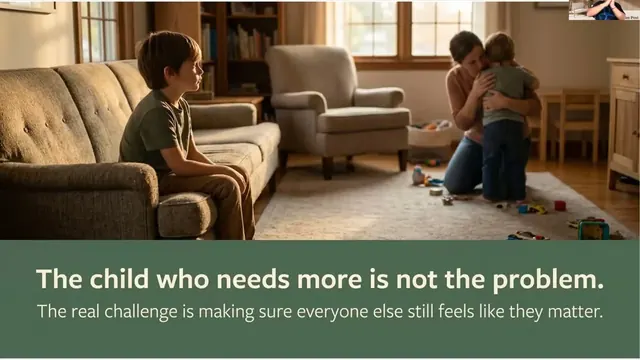
44:07and you have to suspend all that other stuff that you've learned and that you've heard, that you've been taught. You've got to suspend it and you've got to be willing to practice to get over into this different paradigm. Young children borrow their calm from you, not even young children, all children do. Your teen does, your spouse does. If you're the regulated presence, everyone's borrowing their calm from you. When you're the regulated one, because you're the one who's infused with love, you're creating the most loving vibration and everyone's trying to get a little bit of that good feeling. Give me a little bit of that good feeling. Your presence says, I'm here, you're safe, we will get through this. So here's the repair cycle.
44:52We're about to be wrapping up. Mistakes do not end the story. I'm going to tell you all this. The mistakes, here's what I say. Behavior is not the problem, it's the opportunity. Behavior is not the problem, it's the opportunity. Because when your child's in a behavioral place, that behavior is being driven by their own internal trauma energy that's never been released. So when we create the opportunity, the environment and the relationship for the trauma energy to be released through the behavior without us reinforcing it with negativity and stress, then we're actually creating the environment
45:38for healing to occur. But when our child has a behavior problem and we get stressed out and overwhelmed and we're not breathing and we're not thinking clearly and we're shook and then we shut off and we think we're going to die and we don't think we're going to ever get through this ever and we think that when our child is 20, they're going to end up a criminal, then we actually create a vibration that matches their vibration of stress. And when you have a stressed out child and you become stressed, you're just compounding the stress and then guess what, the healing cannot occur because the stress interrupts the release and the expression of the trauma energy. Now, I just said a whole lot in like 60 seconds, but there's a whole breakthrough in that if you can get it. So you listen to this, listen to this again.
46:25And Jasmine, I'm going to give everyone a gift and I don't know if we're doing that with these webinars, but if we're not, I want to do what we're doing for these webinars like we do for our Bondify webinars. So one, I'm going to give you the gift of Bondify. So everyone listening, I'm going to talk about that in a moment. I'm going to give you the gift of Bondify too. On my Wednesday Bondify Q&As, live Q&As, what we do is we record them, then we transcribe them, then we turn them into a workbook and then we provide the recording. So the recording becomes available. I know that we're going to send everyone the recording, but we have not been doing the workbook, but I want to start taking these webinars Jasmine and I want to put them on the same platform where we put the Bondify webinars
47:11and I want everyone to have access to all of those because there's two things that change the brain, repetition and emotional impact. Now the repetition occurs through the ongoing learning. You got to keep learning. If you don't do anything else after this webinar, you're going to forget everything that I said. You're going to forget that you took an hour out of your day, but if you'll continue to learn, if you continue to listen, if you continue to read, then you're going to continue to change your paradigm. The emotional impact happens when your child is in the midst of a behavior challenge. When your child is in the midst of a behavior challenge, you've got to be able to get to a place of presence. Okay, so here's the thing. We have, we call up fear2love.com pathway finder.
47:56There's never anything to sell you guys on any of this stuff. I know, I'm just, I love education. So I love education and I love providing pathways to get you the support that you need. So first is the pathway finder. So you go here, fear2love.com, four slash pathway finder, you complete this little questionnaire and it's going to generate a path for you to be able to get the results that you want. So that's number one. So it's fear2love.com, four slash pathway finder. You can go there, you can use it, it's super cool. It's super cool because it's going to map out for you the path that you need to take in order to get to the transformation that you want. Number two, if you are a family in California,
48:43Northern and Central California specifically, and you're really struggling, if you feel like you're really at risk and your child was adopted from a county within California, then you qualify for AAP. And if you're already getting adoption assistance, then you qualify for wrap around services. Now this is for families that are at risk. Now a lot of you come for the education, that's great, come for the inspiration, the support, that's fantastic. But if I have families on here who are at risk, you're at risk of sending your child to residential, you're at risk of disrupting the adoption, you've tried all kinds of therapy, it hadn't worked, maybe your child's already been to residential. There are two programs in Northern and Central California that can be of support to you. One is LEAF Wraparound.
49:30I founded both of these seven years ago. The other is Love Pathways. They're passionate, committed people that want to support you. So I don't know about this QR code. I don't know if you're on your phone, you can take a picture of the QR code. If you're not, you can send an email to welcome at leafwraparound.com or welcome at lovepathways.org. And these are the counties in California that these two programs serve. All right, last and final gift, Bondify. Bondify is an AI power parenting support app that I created just for you. It's professionals use it to, in fact my daughter who actually is a part of the management runs LEAF Wraparound,
50:17she texted me the other day about a question from a parent. She said, I'm not sure about this. And then she said, but I use Bondify and here's what it gave me. She said, look at me being a little Brian post. Let me tell you something. Go to your Google store, go to your Apple store, wherever it is and look up Bondify. This is a free tool for parents and for professionals, but it was created for parents. This is a tool that was created for parents that needed support in that moment. And you all know what that moment was. It's an AI power parenting support app. It's all based on my information. You can text me and it's gonna be like you're having a conversation with me. I want you to try it. I want you to try it. It's absolutely free. There's no cost. You download it, you start using it.
51:03If you want a programmer with your biggest challenges, I'm gonna be able to give you the best specific recommendations and support. But if you just want to use it generally, you can do that too. Now here's the other thing. Not only do you get the text tool, but there's a lot of education in there. I believe in repetition. So there's a lot of videos, a lot of articles, a lot of different things I've done in the past, books, everything. There's all kinds of resources on there. But there's a whole community of other parents that are on there asking questions, supporting one another, growing. So Bondify is its own community. But the other thing is this is how you get to join me every single Wednesday morning at nine o'clock Central Standard Time.
51:50So seven o'clock Pacific Standard Time. And yes, I know it's early, but let me tell you if I could jump onto this thing and do it at seven in the morning Central Standard Time because that's where I live in Texas, I probably would. But I do nine. So jump up and we always offer a recording. We always offer a workbook. And we always put it on a master site. So you get access to all these free resources. I wanna see you grow. I wanna see you learn. I wanna see you get inspired. I wanna see you get uplifted. And more than anything, I wanna see you create the loving home for your child and for your family that you always dreamed of. And I know it's possible. Now it's gonna be maybe a little bit of an uphill climb, but that's what we're here for.
52:36We're here to offer you that support. We're here to offer you that encouragement. So go to Bondify, you can join. I'll be here tomorrow morning, 9 a.m. Central Standard Time. I'll be here and I'll be doing live questions and answers. And usually those, and it's always an hour long. And if there's not a bunch of Q and A, then I'll lecture on the topic. But it only takes me one question. And I can lecture one hour on one question. And I can guarantee here you're gonna get something from it. So join, download Bondify. It's Bondify.ai. If you go to the website, but just go to your Google store, go to your market and find this on Bondify. So just a quick recap. LEAF Wraparound, Love Pathways.
53:22If you're at risk, adopt a family. Fear to love.com, pathway finder. If you just wanna find out, take the cool little tool, find out what we have to offer for you and what direction you can take to continue to help you grow and learn and get uplifted. And then finally, you do not have to be a perfect parent. This is not about being perfect parents. We're gonna all mess up and that's fantastic. This is about getting better. Getting on a path where you can continue to get better. You just need to learn how to return to calm. When you get upset, you gotta learn how to return to calm. And when you change what you bring into the moment, you change what becomes possible for your child because love is greater than fear.
54:08All right, that's it. God bless you, everyone. Thank you so much for showing up yet again. And we do these Fear to Love webinars. I think we do them once a month. So, I mean, just stay a part of the community if we can support you in any kind of way, reach out to us. Otherwise, thank you so much for joining me. Have an awesome day. You're a fantastic parent. You're a fantastic parent. You're exactly the parent that your child needs and you're gonna get through it and it's gonna be okay. God bless. We'll see everyone soon.